Gain insights from leading experts in your specific areas of interest in physics by participating in pre-meeting short courses and tutorials.
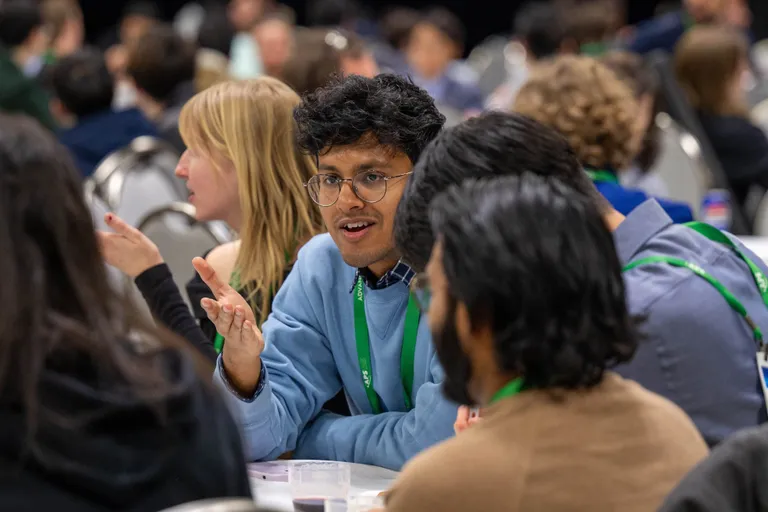
Organized by APS units, these sessions offer unique advantages for students, postdocs, early career physicists, and seasoned professionals alike.
You can sign-up to attend pre-meeting events by registering for the APS Global Physics Summit. You will have the option to register for both pre-meeting events and the APS Global Physics Summit or just for the pre-meeting events.
Unit Short Courses and Workshops
Polymer Physics in the Age of AI, Automation, and Physics-Guided Discovery
DPOLY Short Course
Date/time: Saturday, April 10, 2027, 8 a.m.-5 p.m.
Price:
- Students: $200
- Early career: $225
- Other/retired: $250
- Non-member: $350
Description: The course will introduce attendees to the emerging role of machine learning, automation, and autonomous experimentation in polymer physics. The first session covers foundations of machine learning, generative and agentic AI, polymer representations, uncertainty, extrapolation, inverse design, active learning, and physics-informed or theory-aware models. The second session covers self-driving laboratories for polymer synthesis, characterization, and processing, including robotic synthesis and formulation, Bayesian and multi-objective optimization, high-throughput characterization, AI-guided data analysis, and human-in-the-loop experimental workflows. Throughout, the course emphasizes how data-driven methods can complement polymer-physics intuition, with attention to sparse data, physical constraints, interpretability, reproducibility, and experimental validation.
Disordered Metamaterials
Date/time: Sunday, April 11, 2027, 8 a.m.- 5 p.m.
Price:
- Students: $225
- Non-students: $300
Description: Metamaterials are systems whose geometrical structure leads to bulk physical properties that differ from those of their constituent components. Such systems are the focus of much research due to their wide-ranging exotic and desirable physical properties, including negative refractive indices, negative Poisson ratios, and phononic bandgaps. Metamaterials are interesting from both fundamental and practical perspectives due to the challenging physics problems associated with understanding their behavior and their myriad applications, including mitigation of seismic waves and light-wavefront manipulation for enhanced biomedical imaging. There is particular interest in disordered metamaterials, which have a much larger design space than ordered metamaterials and can yield systems whose physical properties are isotropic and robust to defects that occur during fabrication. In this short course, attendees will be exposed to topics on the cutting edge of disordered metamaterials design and characterization from theoretical, computational, and experimental perspectives. Areas of special interest include: mechanical metamaterials, network-based materials, hyperuniformity, photonic materials, biological and biomimetic materials, granular media, geometrically frustrated systems, and heterogeneous materials.
This short course is appropriate for graduate students, postdocs, and early-career scientists working in soft matter and nonlinear physics who are interested in learning techniques to design and characterize disordered metamaterials from theoretical, computational, and experimental perspectives. Attendees will be exposed to many different subfields of disordered metamaterials, so students and early-career scientists who have focused primarily on a single subfield will gain exposure to the other exciting open areas of disordered metamaterial design and characterization.
Data Science and AI for Physics: Generative Models and Agentic Workflows
Date/time: Sunday, April 11, 2027, 8 a.m.-12 p.m.
Price:
- Students: $75
- Non-students: $100
Description: This tutorial covers advanced techniques from data science and artificial intelligence, showing their applications to solving complex physics problems. The first session will cover generative artificial intelligence models, namely diffusion models, generative adversarial networks (GANs), and variational autoencoders. The session will provide an introduction to each of these methods and will show how these methods can be used to create simulated data across a variety of fields. The second session of this tutorial will cover artificial intelligence agents and demonstrate practical ways they can be applied to physics research workflows.
Data Science and AI for Physics: From Physics Principles to Scientific Applications
Date/time: Sunday, April 11, 2027, 1-5 p.m.
Price:
- Students: $75
- Non-students: $100
Description: This tutorial aims to introduce participants to data science and artificial intelligence techniques being used in modern physics research. The first half of the course will provide an overview of the data life cycle in modern physics, including data acquisition, cleaning, and storage. This session will also provide an introduction to core machine learning paradigms (supervised, unsupervised, and reinforcement learning) tailored for physical data. The second half of the course will teach participants how to integrate physical laws (differential equations, conservation laws) directly into loss functions. This session will also cover overcoming data scarcity in physics experiments using prior structural knowledge.
Integrating Data Science and AI into the Undergraduate Physics Curriculum
Date/time: Sunday, April 11, 2027, 1-5 p.m.
Price:
- Students: $75
- Non-students: $100
Description: This workshop explores ways to incorporate data science and artificial intelligence concepts into undergraduate physics curricula. Participants will discuss instructional approaches, sample activities, and curriculum design strategies for integrating these rapidly growing fields into physics education.
Advocating for Science
Date/time: Sunday, April 11, 2027, 8:30 a.m.-3:45 p.m.
Price:
- Students and postdocs: $50
- Non-students: $100
Who should attend? Graduate students, postdocs, and researchers interested in developing practical skills to advocate for science—whether engaging the public, influencing policymakers, or supporting research funding.
Organizer: Don Lincoln, FermiLab; contact Don Lincoln
Presenters: Nathan Sanders and Claire Lamman (physicists and ComSciCon professional trainers)
Description
The Forum on Physics and Society aims to establish a recurring training program that equips researchers to be effective advocates for science with a “good for society” focus. This goes beyond basic communication skills by building the confidence and techniques needed to connect with communities and motivate them toward meaningful action. This training is not aimed at a specific audience but teaches universally useful techniques. The goal is that the training will be valuable for one participant who might explore direct congressional engagement but also for another interested in developing social-media outreach to encourage underrepresented youth to pursue science.
Participants will leave with foundational advocacy abilities and communication proficiencies. We are partnering with the ComSciCon organization for a full day of training. The training includes a total of seven hours of a mix of instruction, small group activities, and individual practice.
Topics
First module: How to engage with a skeptical public, which includes (amongst several topics):
- Why empathic science communication matters
- Understanding your audience
- Preparing to confront a skeptical public
Second module: How to influence a skeptical society, which includes (amongst several topics):
- Influencing policymakers through op-ed writing
- How to write op-eds for influence and impact on a targeted audience
- Continuing your practice beyond this APS meeting
Tutorials
T1: Hands-On AI for Magnetism: From Materials Discovery to Hamiltonian Inference
Who should attend? Graduate students, postdocs, faculty, and other researchers interested in applying computational tools and AI to magnetic materials and measurements. Basic familiarity with magnetism and notebook-based computing is helpful, but no prior experience with the featured software is required.
Organizers: Peter Fischer, Lawrence Berkeley National Laboratory; and William D. Ratcliff, National Institute of Standards and Technology
Instructors: Patrick Huck, Lawrence Berkeley National Laboratory; William D. Ratcliff, National Institute of Standards and Technology; and Kipton Barros, Los Alamos National Laboratory
Description: Artificial intelligence and open scientific tools are changing how magnetic materials are discovered, modeled, and measured. The tutorial will consist of four one-hour modules, each combining a pedagogical lecture with a guided browser-based notebook. Prepared notebooks will be provided. Participants will follow an integrated workflow from materials discovery to Hamiltonian inference.
Topics:
- Using the Materials Project to identify magnetic compounds, MAGNDATA to obtain reported magnetic structures, and information from related materials to construct an initial spin Hamiltonian.
- Using Sunny.jl to calculate spin-wave spectra and neutron-scattering intensities.
- Using Bayesian optimization and active learning to select informative simulated neutron-scattering measurements and infer Hamiltonian parameters.
T2: Rhombohedral Graphene: New Ground for Quantum Phases and Quantum Information
Who should attend? Graduate students, postdocs, and other scientists interested in 2D materials, topological matter, correlated electrons, superconductivity, magnetism, quantum Hall effect, nano fabrication, and quantum information science. Particularly those interested in learning about the exciting discoveries and opportunities in rhombohedral graphene systems.
Organizer: Marc Bockrath, The Ohio State University
Presenters: Long Ju, MIT; Ali Yazdani, Princeton University; Fan Zhang, University of Texas at Dallas; and Klaus Ensslin, ETH Zürich
Description: Rhombohedral graphene (RG) has rapidly emerged as one of the most versatile and powerful quantum material platforms discovered to date. Over the past few years, a remarkable variety of strongly correlated electron phases has been experimentally discovered and reproduced across the RG family, including AB bilayer, ABC tri-layer, ABCA tetra-layer, ABCAB penta-layer, and even thicker multilayers. These phases include not only layer antiferromagnets and large-Chern-number quantum anomalous Hall states at charge neutrality, but also Wigner and Hall crystals, Stoner isospin ferromagnets, orbital multiferroics, and multiple spin singlet and triplet superconductors at low carrier densities. When aligned with hBN to form Moiré superlattices, RG further hosts a series of fractional quantum anomalous Hall states.
Together, these discoveries establish RG as a unique and highly tunable platform in which four central themes of CMP—superconductivity, magnetism, topology, and fractionalization—can be explored side by side, can even coexist within a single phase, and can be continuously controlled through electric field, substrate coupling, carrier density, and layer thickness. In parallel, quantum dot experiments have demonstrated competitive relaxation and coherence times, highlighting the promise of RG for quantum information science. Given the rapid pace of recent breakthroughs and growing interest in the field, this tutorial is both timely and broadly relevant. The four lecturers, who have collectively pioneered many of the key advances in the field, will provide a pedagogical and comprehensive introduction to RG, outlining the outstanding challenges and opportunities that define this rapidly evolving research frontier.
Topics:
- Nano fabrication, quantum transport, and optoelectronics
- Scanning tunneling microscopy and scanning tunneling spectroscopy
- Theory and modeling
- Quantum dots and quantum information
T3: Thriving Education Day I: Practical Classroom Frameworks for Enhancing Physics Practice and Learning
Who should attend? Faculty, instructors, and staff who want to support all physics students and learners. The session will provide participants with a range of evidence-based teaching strategies, including opportunities for them to practice these techniques and to develop “next steps” action plans for what they will do with the workshop materials.
Organizer: Christine O’Donnell, APS
Presenters: Marty Baylor, Carleton College; Andrew Boudreaux, Western Washington University; and Gina Passante, California State University Fullerton
Description: Educating and preparing the next generation of physicists is a key responsibility of the physics community. In this two-part Tutorial, participants will engage with four different research- and evidence-based approaches that any instructor can incorporate into their classrooms. Each session will be interactive, providing participants with hands-on practice, and will conclude with an action-planning reflection that guides participants to identify how they might incorporate something from the session in their own teaching (e.g., into a particular course/unit) and/or share with colleagues in their department. In between the morning and afternoon parts, all participants will be invited to a networking lunch to connect directly with workshop facilitators, APS staff, and leaders in education-related units and committees.
Part I will feature two approaches that support students’ scientific thinking, problem solving, and sense of belonging in physics. First, the Practicing Professionalism Framework (PPF) helps students develop a professional-like approach to building core physics knowledge and discipline-specific skills while authentically engaging with broader topics such as the history of physics, social justice and equity in a physics context, outreach, and public policy. Second, participants will engage with active learning practices from the AAPT/APS/AAS Physics and Astronomy Faculty Teaching Institute (FTI), such as think-pair-share, whiteboarding, and other active-learning strategies. Both sessions will provide flexible structures that can be adapted to a wide range of instructional settings.
Topics:
- Connecting course content to professional practice of physicists
- Fostering a sense of inclusion and belonging in physics by connecting with the broader physics community and broader society
- Using active learning techniques for physics courses
- Implementing the frameworks and practices covered in the tutorial; resources with practical strategies will be provided
T4: High-Dimensional Quantum Codes and Decoding
Who should attend? This introductory tutorial is designed for scientists and engineers interested in the design and implementation of first-generation fault-tolerant quantum computing systems and subsequent advancements. The tutorial material, which spotlights nascent work on qudits, teaches theoretical and practical quantum error correction from first principles and is broadly applicable to qubits. As fault-tolerance encompasses multiple design layers, the intended audience includes hardware designers focusing on noise suppression, coding theorists specializing in error correction, and computer architects working on noise tolerance. A basic familiarity with quantum computing is assumed, and familiarity with Python is recommended for the guided computational exercises.
Organizers: Yipeng Huang, Rutgers University; and Isaac Kim, University of California Davis
Instructors: Sohan Ghosh, University of California Davis; Adeeb Kabir, Rutgers University; Steven Nyugen, Rutgers University; and James Keppen, KU Leuven and Riverlane
Description: The realization of fault-tolerant quantum computing necessitates that information be reliably encoded, processed, and measured in the presence of noise during gate operations, state preparation, and idling. While quantum error-correcting codes form the bedrock of this endeavor, the resource overhead of standard approaches motivates exploring architectures based on high-dimensional systems. This tutorial offers a pedagogical overview of error correction and decoding, focusing on qudit stabilizer codes and computational simulation.
- Part 1 introduces first principles, moving from classical redundancy and repetition codes to qudit states, generalized gates, and the unique constraints of the quantum regime.
- Part 2 formalizes the stabilizer framework, covering generalized Pauli operators, code distance, and the Knill-Laflamme conditions. Participants will employ Sdim, an open-source qudit simulator, to build circuits and execute stabilizer measurements.
- Part 3 surveys code families including topological, Quantum Reed-Muller, and qLDPC codes, analyzing tradeoffs in rate, locality, and hardware connectivity.
- Part 4 addresses decoding and fault tolerance, exploring detector-error models, graph-based decoders, and threshold extraction. Guided computational exercises will bridge mathematical theory with practical workflows for simulating and characterizing noisy quantum circuits.
Topics:
- Theory: High-dimensional spin systems, quantum stabilizer formalism, information theory, surface codes, Reed-Muller codes, graph decoding algorithms
- Computational workflow and characterization: Randomized benchmarking, error models, threshold extraction, detector-error models, automated code concatenation
T5: Control Theory In Biological Physics: Theory and Experiment
Who should attend? Graduate students, postdocs, and researchers in biological physics who want to learn how control theory describes feedback, stability, and robustness in living and active systems, and how to use it in their own models and experiments. The talks are pedagogical, from the basics of feedback control to the thermodynamic limits of control at the molecular scale and the control of active matter. No prior controltheory background is assumed.
Organizer: Moumita Das, Rochester Institute of Technology
Instructors: José Alvarado, University of Texas at Austin; John Bechhoefer, Simon Fraser University; Suraj Shankar, University of Michigan, Ann Arbor; and Suriyanarayanan Vaikuntanathan, University of Chicago
Description: Living systems regulate themselves. They hold internal states steady against a changing environment, adapt to persistent signals, and act under noise and energy constraints. Control theory is the quantitative language of feedback, stability, and robustness, and it is now central both to understanding how biological function arises and to steering these systems in experiments.
This tutorial introduces control theory for a biological physics audience and connects it to experiment. It begins with the core ideas any physicist can use: open- versus closed-loop control, feedback and feedforward, transfer functions, stability, and robustness. It then turns to the stochastic and thermodynamic setting of molecular-scale biology, where noise, dissipation, and information set limits on controller performance. Information engines and feedback traps realize these limits in the lab. The final part treats the control of active matter and living systems, where internal driving produces flows, patterns, and shape. There, optimal and geometric control methods supply design principles for steering them. Throughout, the tutorial pairs theory with experiment, including real-time feedback control of single particles and the measurement and control of reconstituted active gels.
The topic is timely: experimental platforms now let biophysicists measure and steer living systems in real time, and stochastic thermodynamics has set the limits on the speed, precision, and energy cost of control. It connects to DBIO’s core interests in the nonequilibrium physics of living systems and active matter, and to broader APS interests in feedback, information, and the thermodynamics of control.
Topics:
- Foundations of control for physicists, and real-time feedback: open- and closed-loop control, feedback and feedforward, transfer functions, stability, and robustness; and their realization in information engines, feedback traps, and closed-loop control of single particles.
- Stochastic thermodynamics of control: feedback under noise, information-to-energy conversion, and the thermodynamic and information-theoretic limits and costs of control at the molecular scale.
- Control of active matter and living systems: steering spontaneous flows, defects, and morphogenesis using optimal control, optimal transport, and symmetry-based methods.
- Measuring and controlling biological active materials: system identification of reconstituted active gels, input-output and impulse response, and the mechanical response of the cytoskeleton to control signals.
T6: Understanding Density Functional Theory: From Fundamentals To Machine Learning
Who should attend? Graduate students, postdoctoral researchers, and other scientists interested in learning the essential elements of Density Functional Theory (DFT), both in its ground-state and time-dependent formulations. The tutorial talks will be pedagogical, covering the fundamentals of the theory together with representative applications, recent developments, and outstanding challenges. This tutorial will provide an excellent introduction to the many talks using DFT at the APS Global Physics Summit.
Organizer: Adam Wasserman, Purdue University
Instructors: John Perdew, Tulane University; Kieron Burke, University of California, Irvine; Carsten Ullrich, University of Missouri; and Neepa Maitra, Rutgers University–Newark
Description: Density Functional Theory (DFT) provides a practical route for calculating the electronic structure of matter at all levels of aggregation. More than six decades after its inception, it is now routinely used in many fields of research, from materials engineering to drug design. Time-Dependent Density Functional Theory (TDDFT) has extended the success of DFT to time-dependent phenomena and excitations. Most applications are carried out in the linear-response regime to describe excitation and emission spectra, but the theory is applicable to a much broader class of problems, including ultrafast and strong-field processes, as well as non-adiabatic dynamics of coupled electron-nuclear systems.
The tutorial will provide an introduction to the basic formalism of DFT and TDDFT, an overview of state-of-the-art functionals, applications, and open questions, together with a discussion of recent efforts to combine DFT with machine learning for both functional development and accelerated electronic-structure calculations.
Topics:
- DFT: Basic theorems of ground-state DFT, with simple examples; exchange-correlation functionals and exact conditions such as scaling, self-interaction, and derivative discontinuities; the Jacob's Ladder of density functional approximations; symmetry breaking and strong correlation; exact exchange and beyond; recent efforts to use machine learning to develop improved density functional approximations and accelerate large-scale DFT calculations; extensions to warm dense matter and ensembles may also be discussed.
- TDDFT: Basic theorems of TDDFT, with simple examples; survey of time-dependent phenomena; exact conditions and memory dependence; linear response and excitation energies; optical processes in materials; multiple and charge-transfer excitations; ultrafast and strong-field processes; extensions such as coupled electron-nuclear dynamics and quantized photons.
T7: Altermagnets: From Models to Materials
Who should attend? Graduate students, postdoctoral researchers, and scientists who are interested in learning about the current state-of-the-art in the field of altermagnetism. The lectures will be accessible and pedagogical, presenting plenty of introductory material without assuming any prior research experience in the topic. The tutorial consists of four complementary lectures focusing on fundamental theoretical and experimental concepts and advances related to altermagnetism, from microscopic and phenomenological models to experimental probes and material candidates.
Organizers: Rafael Fernandes, University of Illinois Urbana-Champaign; and Nirmal Ghimire, University of Notre Dame
Instructors: Daniel Agterberg, University of Wisconsin-Milwaukee; Rafael Fernandes, University of Illinois Urbana-Champaign; Nirmal Ghimire, University of Notre Dame; and Peter Wadley, University of Nottingham
Description: Altermagnets have emerged as a new class of magnetically ordered states whose properties are somewhat intermediate between those displayed by ferromagnets (split spin-up and spin-down bands) and by standard Néel antiferromagets (compensated magnetic moments). What distinguishes these three types of collinear magnetic orders is the crystalline symmetry that relates spins of opposite directions (time reversal). Ferromagnets have no symmetry relating opposite spins, since all spins are aligned. Conventional antiferromagnets remain invariant when time reversal is combined with inversion or translation. Altermagnets, on the other hand, are invariant under time reversal combined with a rotation, which can be a proper rotation, a screw rotation, a mirror reflection, or a glide. Because of these unique symmetries, altermagnets exhibit a plethora of special microscopic and macroscopic properties. The nodal structure of the spin splitting in the electronic dispersion is perhaps the best-known example. However, altermagnetism also leaves unique fingerprints in several other properties: magnetic spectrum (chiral magnons), electronic topology (multipolar Berry curvature), pairing susceptibility (suppression of singlet pairing), and mechanical strain response (piezomagnetism and elastoresistivity). As a result, altermagnets offer a promising platform for a broad range of research topics in condensed matter physics, including ultrafast spintronics, unconventional superconductivity, and electronic topology.
This tutorial aims to provide an accessible introduction of this rapidly evolving field to a broad audience interested in different condensed matter physics problems. As such, it will present topics ranging from introductory material related to the theoretical and experimental bases of altermagnetism to exciting recent advances and open questions in the field.
Topics:
- Phenomenology: symmetry constraints; connection with magnetic multipoles; role of spin-orbit coupling; responses to strain and to electromagnetic fields.
- Microscopic models and mechanisms: role of electron-electron interactions; superconducting properties; non-trivial quantum geometry; interplay with the lattice degrees of freedom.
- Experimental probes: momentum-space and spin-resolved spectroscopy; transport properties; imaging; domain engineering.
- Materials synthesis: status of known altermagnetic compounds; growth of new candidate materials; heterostructures and thin films.
T8: Quantum Monte Carlo Methods for Strongly Correlated Electronic Systems
Who should attend? Graduate students, post-docs, and researchers without strong numerical backgrounds.
Organizer: Steven Johnston, University of Tennessee, Knoxville
Presenters: Richard Scalettar, University of California, Davis; Thomas Maier, Oak Ridge National Laboratory; Kipton Barros, Los Alamos National Laboratory; Ben Cohen-Stead, University of Tennessee, Knoxville; and Steven Johnston, University of Tennessee, Knoxville
Description: Quantum Monte Carlo (QMC) algorithms are a powerful family of methods for performing numerically exact nonperturbative simulations of quantum many-body systems. These methods have been successfully applied in many different fields of physical science, and often represent the gold-standard for obtaining unbiased results for model Hamiltonians in condensed matter physics. Crucially, user-friendly and open-source implementations of different QMC algorithms are now widely available, which have significantly lowered barriers to entry into this field.
Topics:
- Broad overview of QMC methods for quantum many-body systems with a focus on correlated lattice models with and without electron-phonon interactions.
- The theory underpinning modern QMC methods, targeting popular determinant and continuous time QMC methods, as well as quantum embedding algorithms like dynamical mean-field theory and the dynamical cluster approximation.
- Novel sampling algorithms like hybrid (or Hamiltonian) Monte Carlo, a powerful for sampling continuous degrees of freedom and now enable efficient simulations of electron-phonon models.
- Hands-on training installing and running different open-source codes by the organizers for non-trivial use cases. These hands-on components will make extensive use of the SmoQyDQMC.jl and DCA++ software packages.
T9: Thriving Education Day II: Assessing & Supporting Students’ Physics Reasoning Skills
Who should attend? Faculty, instructors, and staff who want to support all physics students and learners. The session will provide participants with a range of evidence-based teaching strategies, including opportunities for them to practice these techniques and to develop “next steps” action plans for what they will do with the workshop materials.
Organizer: Christine O’Donnell, APS
Presenters: Suzanne White Brahmia, University of Washington; Trevor Smith, Rowan University; Beth Lindsey, Penn State Greater Allegheny; MacKenzie Stetzer, University of Maine; and Mila Kryjevskaia, North Dakota State University
Description: Educating and preparing the next generation of physicists is a key responsibility of the physics community. In this two-part Tutorial, participants will engage with four different research- and evidence-based approaches that any instructor can incorporate into their classrooms. Each session will be interactive, providing participants with hands-on practice, and will conclude with an action-planning reflection that guides participants to identify how they might incorporate something from the session in their own teaching (e.g., into a particular course/unit) and/or share with colleagues in their department. In between the morning and afternoon parts, all participants will be invited to a networking lunch to connect directly with workshop facilitators, APS staff, and leaders in education-related units and committees.
Part II will highlight two further efforts that focus on students’ reasoning skills. First, participants will use the Physics Inventory of Quantitative Literacy (PIQL) to identify specific student bottlenecks in mathematical reasoning. These diagnostic data serve as the foundation for targeted instructional improvements developing students' mathematical reasoning skills in physics contexts. Second, participants will consider the factors that shape students’ reasoning such as conceptual understanding, intuition, cognitive biases, and contextual features. Using a framework from dual-process theories of reasoning, participants will learn about assessment techniques and analyze examples of student responses. Both sessions will provide participants with research-validated and practical toolkits, including classroom-ready activities to scaffold and grow students’ reasoning skills.
Topics:
- Improving quantitative reasoning in physics contexts
- Supporting students to reason productively about physics problems by applying dual-process theories of reasoning
- Exploring reasoning assessments and analyzing student responses
- Implementing the frameworks and practices covered in the Tutorial; resources with practical strategies will be provided
T10: Dealing with Noise in a Quantum Computer
Who should attend? Graduate students, post-docs, and researchers interested in the theoretical and experimental issue of noise and error mitigation. This tutorial is ideal for scientists working in quantum computing, quantum information science, or related areas.
Organizer: Mohammad Hafezi, University of Maryland
Presenters: Alireza Seif, IBM; and Michael Gullans, University of Maryland, NIST, and Quera
Description: Noise is the central obstacle standing between today's quantum processors and useful, scalable computation. This tutorial gives attendees a coherent picture of the techniques for dealing with it. We start by describing mathematically how noise impacts a quantum computation, move on to near-term methods that suppress and mitigate its effect on measured quantities, and end with the error-correcting architectures that promise arbitrarily reliable computation. The tutorial assumes familiarity with basic quantum mechanics and the circuit model but requires no prior background in open quantum systems or coding theory.
Topics:
- Modeling Noise and Error Mitigation:
- The language for describing imperfect quantum hardware.
- Quantum channels as the general framework for open-system evolution and completely positive trace-preserving maps; Kraus and Pauli-transfer-matrix representations.
- Continuous-time dynamics: the Lindblad master equation, dissipators and relaxation and decoherence; how coherent errors differ from incoherent, stochastic ones.
- Circuit models: noise as maps interleaved with the ideal gates of a quantum circuit; how gate and measurement errors compose across circuits.
- Characterizing noise directly at the circuit level on real devices: randomized benchmarking, cycle benchmarking, and tomographic methods; when a simplified Pauli model is faithful enough to be useful.
- Error mitigation: techniques that reduce the bias in estimated observables without the qubit overhead of full correction.
- Zero-noise extrapolation, probabilistic error cancellation, readout error mitigation, and symmetry-based post-selection.
- Sampling overhead and the fundamental reasons mitigation cannot scale indefinitely.
- Near-term capability to perform error detection; how mitigation techniques can be combined with both error detection and error correction
- The language for describing imperfect quantum hardware.
- Quantum Error Correction
- General introduction to the theory of quantum error correction and fault-tolerant quantum computing.
- Quantum error correcting codes using the stabilizer code formalism.
- Fault-tolerant quantum computing through composable circuit gadgets.
- Fault-tolerant compiling from the perspective of magic state preparation and gate teleportation.
- Time permitting: Advanced topics in fault-tolerance; spacetime code mapping; quantum error correcting code constructions based on quantum low-density parity check codes.
T11: Thinking Big with Small Data in Cell Biology
Who should attend? This course will be useful to theorists who would like to sharpen their knowledge and skills needed to effectively engage with experimental data, as well as experimentalists who would like to understand better what sort of information can be inferred from data and how to best collect data to rigorously test models.
Organizers: Ariel Amir, Weizmann Institute of Science; and Jane Kondev, Brandeis University
Instructors: Jane Kondev, Brandeis University; Ethan Levien, Dartmouth College; Ariel Amir, Weizmann Institute of Science; and Lishibanya Mohapatra, Rochester University
Description: While "Omics" biological research often involves large data sets, in the physics of living systems data is often limited in size. Therefore, to infer relevant biological mechanisms, requires a clever analysis that may involve mathematical and biophysical models, statistical analysis, or both. In this short course we will describe some of these methods and illustrate them on specific biological examples taken from our own research experiences (e.g. Cytoskeleton assembly in yeast, DNA replication and cell division in E. coli).
Topics:
- Estimates and scaling: How to estimate the size of the relevant dimension-full quantities and look for scaling relations that shed light on molecular and cellular scale mechanisms.
- Bayesian inference: How to select between different mathematical models based on available molecular or cellular data.
- Causal inference: How to go beyond two-variable correlations, and use conditional correlation tests to interrogate models and obtain constraints on causality.
- Experimental design and dealing with noise: how can we design informative measurements and perturbations that best distinguish between competing models? How do we distinguish between the intrinsic biological noise, measurement noise, and extrinsic noise associated with environmental fluctuations?
T12: Resonator Characterization and Precision Frequency Tracking: From Fundamentals to Advanced Methods
Who should attend? Graduate students, post-docs, and other scientists interested in learning about microwave resonator physics, characterization techniques, and state-of-the-art methods for real-time resonance frequency tracking. The lectures will provide a pedagogical introduction to resonator sensing platforms, their experimental realization, and their measurement capabilities.
Organizer: Arash Fereidouni, Zurich Instruments
Presenters: James Phillips, Zürich Instruments; Christian Dille, Rohde and Schwarz; Taekwan Yoon, Zürich Instruments; and Arash Fereidouni, Zürich Instruments
Description: Microwave-frequency resonators have established themselves as powerful sensing platforms across a wide range of scientific and industrial applications, converting changes in physical quantities (e.g. temperature, pressure, strain, and molecular composition) into precise frequency shifts. Their utility spans classical sensing all the way to quantum systems. Central to all of these applications is the ability to accurately characterize the resonator's spectral properties and to track its resonance frequency in real time with high stability.
Phase-Locked Loop (PLL) methods are useful and ubiquitous, but are susceptible to phase errors arising from parasitic impedance and cable-induced microphonic noise. The Pound-Drever-Hall (PDH) technique offers a compelling alternative for microwave resonator sensing. When implemented using fully digital, FPGA-based lock-in amplifiers, PDH provides parasitic-immune frequency tracking, suppression of spurious acoustic modes, and an Allan deviation more than an order of magnitude lower than PLL over a broad range of averaging times. These advances open new possibilities for high-precision resonator based sensors, including surface acoustic wave (SAW) devices, MEMS, and superconducting resonators.
This tutorial will cover the physics and measurement science underlying these methods. Lectures will provide a foundational introduction to resonator physics, standard and advanced characterization methods, the theory and implementation of PDH-based tracking, and emerging applications in quantum sensing and hybrid quantum systems.
Topics:
- Theory: Resonator Physics and Spectral Characterization - Basics of microwave resonators including quality factor, lineshape, coupling geometry, and Fano interference. Transfer function measurement, notch vs. reflection geometries, and extracting center frequency and linewidth.
- Standard Tracking Methods — PLLs: Operating principles of Phase-Locked Loops, their role in real-time frequency tracking, and their fundamental limitations, including susceptibility to parasitic phase errors from stray capacitance, cable delay, and microphonic noise.
- Advanced Tracking — The Pound-Drever-Hall Technique: Theory of PDH frequency modulation and error signal generation. Direct detection vs. double demodulation. Digital implementation using FPGA-based lock-in amplifiers. Suppression of spurious acoustic modes through sideband tuning. Comparison of PLL and PDH frequency stability via Allan deviation analysis.
- Applications: High-precision sensing of temperature, pressure, strain, and chemical species. Integration of SAW resonators into hybrid quantum systems with superconducting qubits. Quantum-limited sensing and phonon-mediated quantum state transfer.
More information
Attend the meeting
Get ready to attend the world's largest gathering of physicists.
About APS Global Physics Summit 2026
Learn who attends and why 2026 is an important year to join us.